
'The bull market cycle ran for five years. It's the end of that cycle.' 'The next cycle is a down cycle, and in that down cycle, you will see the Sensex falling from their highs of around 68,000 to maybe 40,000-50,000 at the bottom of the cycle.'
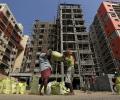
The biggest risk in under-construction projects is delay and non-completion.

GST rate for petrol and diesel cars and hybrid vehicles is already at the highest bracket of 28 per cent plus cess.

The government intends to continue with the top GST slab of 28 per cent for luxury and sin goods, but is open to discuss narrowing down the three slabs of 5, 12 and 18 per cent into two, Revenue Secretary Tarun Bajaj said on Monday. Addressing the industry leaders, Bajaj said the rate rationalisation exercise of the GST Council is a result of introspection of GST, five years after its rollout, and the policymakers do not have a "fetish" to raise the tax rates to the revenue-neutral level of 15.5 per cent. On the industry demand for bringing petroleum products under GST net, he said since fuel constitutes a larger part of their revenues, both the Centre and states have some apprehension.

The liquidity will move into deficit after advance tax payments and GST outflows. It will rebound in October because of government spending.
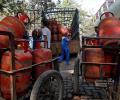
The government is likely to provide a subsidy of Rs 35,000 crore to state-owned Indian Oil Corporation Ltd (IOC), Bharat Petroleum Corporation Ltd (BPCL), and Hindustan Petroleum Corporation Ltd (HPCL) to make up for losses they incurred on selling the fuel this fiscal, sources said.

The new tax rates will come into effect from January 1, 2019.

About a dozen states cutting across party lines on Wednesday pitched for extending the mechanism to compensate states for revenue lost from the implementation of GST beyond June 30, but no decision was taken. Briefing reporters about deliberations at the two-day meeting of the GST Council in Chandigarh, Union Finance Minister Nirmala Sitharaman said finance and other ministers of 16 states spoke on the compensation issue. Of the 16 states, 3-4 spoke of evolving their own revenue stream to break from the compensation mechanism, she said.

Agriculture implements that are currently taxed up to 18 per cent may come under the 12 per cent or the 5 per cent bracket.
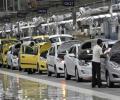
The government on Friday announced several relief measures including deferring one-time registration fee, lifting the ban on purchase of petrol/diesel vehicles by its departments and allowing higher depreciation, but it remained non-committal on the demand for a reduction in GST rates.
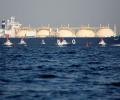
The government should bring natural gas under the Goods and Services Tax (GST) regime to realise Prime Minister Narendra Modi's vision for a gas-based economy and raising the share of the environment-friendly fuel in India's energy basket, an industry body that represents the likes of Reliance Industries as well as state-owned firms, has said. Natural gas is currently outside the ambit of GST, and existing legacy taxes -- central excise duty, state VAT, central sales tax -- continue to be applicable on the fuel. In its pre-Budget memorandum to the finance ministry, Federation of Indian Petroleum Industry (FIPI), which boasts of members from across the oil and gas spectrum, also demanded rationalisation of GST on transportation of natural gas through pipeline as well as on re-gasification of imported LNG to help bring down cost of the environment friendly fuel.

Dr Nagesh Kumar, one of the three new MPC members, wanted the MPC to reduce the repo rate by 25 basis points to 6.25%.

'Spend, but create assets, spend but make sure that people benefit from it.' 'This has been a beautiful guiding principle. And I think as a finance minister I owe so much to the prime minister for keeping this path clear before us.'
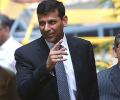
With 7 per cent economic growth, India is not creating enough jobs as reflected by the number of applicants for vacant posts in some states, Reserve Bank's former governor Raghuram Rajan said and suggested the government needs to focus on promoting labour-intensive industries to generate employment. Rajan further said some Indians, especially those at upper level, are comfortable and have high incomes, but consumption growth from the lower half of the country has still not recovered to pre-pandemic level.

Leader of Canada's New Democratic Party (NDP) Jagmeet Singh has announced that he is withdrawing support to Prime Minister Justin Trudeau's government.

An increase in the farmer income support scheme PM Kisan Nidhi, the introduction of a 'robot tax' to fund reskilling of people who lose their jobs to artificial intelligence (AI), and a reduced income-tax (I-T) to bring relief to the middle classes - these are some of the items in the Budget wish list submitted by Sangh Parivar affiliates to Finance Minister (FM) Nirmala Sitharaman. Representatives of the affiliates of the Rashtriya Swayamsevak Sangh (RSS), such as the farmer organisation Bharatiya Kisan Sangh (BKS); trade union Bharatiya Mazdoor Sangh (BMS); Laghu Udyog Bharati, which works for micro and small industries; and Swadeshi Jagran Manch (SJM), which works on economic and policy issues, met the FM and other officials over the last couple of weeks as part of the pre-Budget consultations.
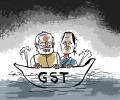
Agra has long been known for the Taj Mahal, but it is also a manufacturing hub filled with micro, small and medium enterprises (MSMEs) that make everything from electronic components to metal products, from paints and chemicals to footwear. And five years after the introduction of the Goods and Services Tax (GST), the MSMEs here complain that while the indirect tax regime has been transformative, cutting out the need to file multiple taxes, its biggest drawback has been the delay in credit refunds. Whoever you speak to - MSME owners, tax lawyers, or industry bodies like the National Chambers of Industries and Commerce (NCIC), Agra Footwear Manufacturers and Exporters Chamber (AFMEC) and Agra Shoe Manufacturers Association (ASMA) - they all emphasise that the GST continues to face some key challenges.

The best way to achieve financial security isn't by cutting out every vada pav or limiting yourself to home-cooked meals; it's by making yourself indispensable at work, says Vatsal Ramaiya.

Other decisions piled up include rationalisation of GST rate slabs, correction of inverted duty on certain items and inclusion of petroleum products.

It has hiked prices of diesel variants of Ciaz and Ertiga models with smart hybrid technology

The cess levied on top of the maximum 28 per cent tax rate on petrol vehicles with capacity to carry 10-13 persons has been reduced to 1 per cent and the same for diesel vehicles has been cut to 3 per cent.
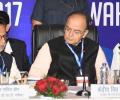
"This rationalisation is 3-4 month exercise," he said, adding that the GST Council decided on the rate cut on the recommendation of a Fitment Committee.
Any judgement on whether the March numbers reflect sustainable growth in GST collection should ideally await the numbers that will be out in May, points out A K Bhattacharya.

There have been complaints from consumers that the firm has increased the base price of products and then charged the lower GST rate, thereby keeping the MRP of products the same in pre and post tax rate cut.
The collections stood at Rs 98,202 crore in the month, against Rs 1.02 trillion in July. The figures indicate continuation of economic slow down which was reflected in the gross domestic product (GDP) growth which plummeted to a 25-quarter low of 5 per cent in the first quarter of 2019-20, experts said.

The broader markets were also in top gear, with the BSE midcap index surging by 2.1% at 11,431 and the smallcap index gaining 1.4% at 11,735.
If the items and services such selected subsequently pass the test from the fitment committee and the GST Council, this would be the first of such rate hikes, after a series of cuts in the process of rate rationalisation that started in November 2017.
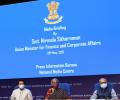
The GST Council on Friday left taxes on COVID-19 vaccines and medical supplies unchanged after the BJP- and Opposition-ruled states sparred over whether tax cut benefits will reach the common man. Congress and other Opposition ruled states have been demanding a reduction in taxes but the central government felt the move may not result in tangible gains for people. "It is one thing to rush to say - do this, it will benefit the common man. But when the technical, fitment and law committees go into the details, you realise that that could have collateral impact on many others," Finance Minister Nirmala Sitharaman said. "I am not talking about the revenue generation aspect, but how many other items will get included in it as a result of which how you are going to implement it," she added.
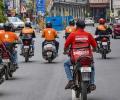
The all-powerful GST Council on Friday decided to charge food delivery platforms such as Swiggy and Zomato a tax even as it extended concessional tax rates on certain COVID-19 drugs by three months till December 31. The Council, which comprises the Union finance minister and her state counterparts, decided to continue keeping petrol and diesel out of the GST purview as subsuming the current excise duty and VAT into one national rate would impact revenues. Briefing reporters on the decisions taken by the Council at a meeting here, Union Finance Minister Nirmala Sitharaman said GST has been exempted on muscular atrophy drugs like Zolgensma and Viltepso, which cost crores of rupees.

GST on 17 items used by middle class viz Paints, Refrigerators, washing machines, vacuum cleaners, storage water heaters, TVs up to 68 cm was reduced from 28 to 18 per cent.

'You may see some movement indicating a simpler tax regime with less exemptions but with fewer tax rates making life simpler for taxpayers.'
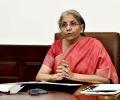
Amid record-high fuel prices, Finance Minister Nirmala Sitharaman on Monday said there is no proposal as of now to bring crude oil, petrol, diesel, jet fuel (ATF) and natural gas under the Goods and Services Tax (GST). When the GST was introduced on July 1, 2017, amalgamating over a dozen central and state levies, five commodities - crude oil, natural gas, petrol, diesel, and aviation turbine fuel (ATF) - were kept out of its purview given the revenue dependence of the central and state governments on this sector. This meant that the central government continued to levy excise duty on them while state governments charged VAT. These taxes, with excise duty, in particular, have been raised periodically.

Strong gains in Vedanta Ltd, Adani Ports, Bharti Airtel and Maruti Suzuki helped the index touch record levels.
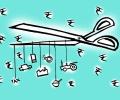
GST Council extends anti-profiteering authority's tenure, sends rate cut on EVs to fitment panel and also extended the date for filing annual returns under the GST by two months to August 30.

Amid an outcry over record high petrol and diesel prices, Union Finance Minister Nirmala Sitharaman on Saturday said the Centre and state governments will have to together work out a mechanism to bring retail rates to reasonable levels.

The liquidity in the banking system moved into surplus almost after three months as the Reserve Bank of India (RBI) absorbed over Rs 40,000 crore from the market on Monday, predominantly on the back of increased government spending. However, this situation may be short-lived given the higher demand for funds to pay taxes and year-end targets, treasury executives said. Meanwhile, two variable reverse repo rate (VRRR) auctions held on Tuesday received weak response.

The Goods and Services Tax (GST) Council, chaired by Union Finance Minister Nirmala Sitharaman, will likely consider on Saturday a GST rate cut for Covid-19 relief essentials and drugs for treating the black fungus disease and might leave the vaccines untouched. The meeting is being held following a report submitted by a Group of Ministers (GoM) to the GST Council on Monday. The GoM, set up by the Council on May 28, was mandated to look at tax exemption and concessions on various Covid items including vaccines, drugs, and equipment.

'Credit card debt comes with high interest cost and stringent penalties.' 'If you do not repay on time, the costs balloon.'

'Like every Budget, this time, too, there is chatter around tinkering with the long-term capital gains tax.' 'Investors may not want to jump into the markets until there is clarity on this front.'
The total revenue earned by central government and state governments after regular settlement in December was Rs 43,851 crore for CGST and Rs 46,252 crore for SGST.
 © 2026 Rediff.com - Advertise with us - Disclaimer - Privacy Policy - Sitemap - Feedback - About us - Terms of use - Grievances